Overview & Key Insights
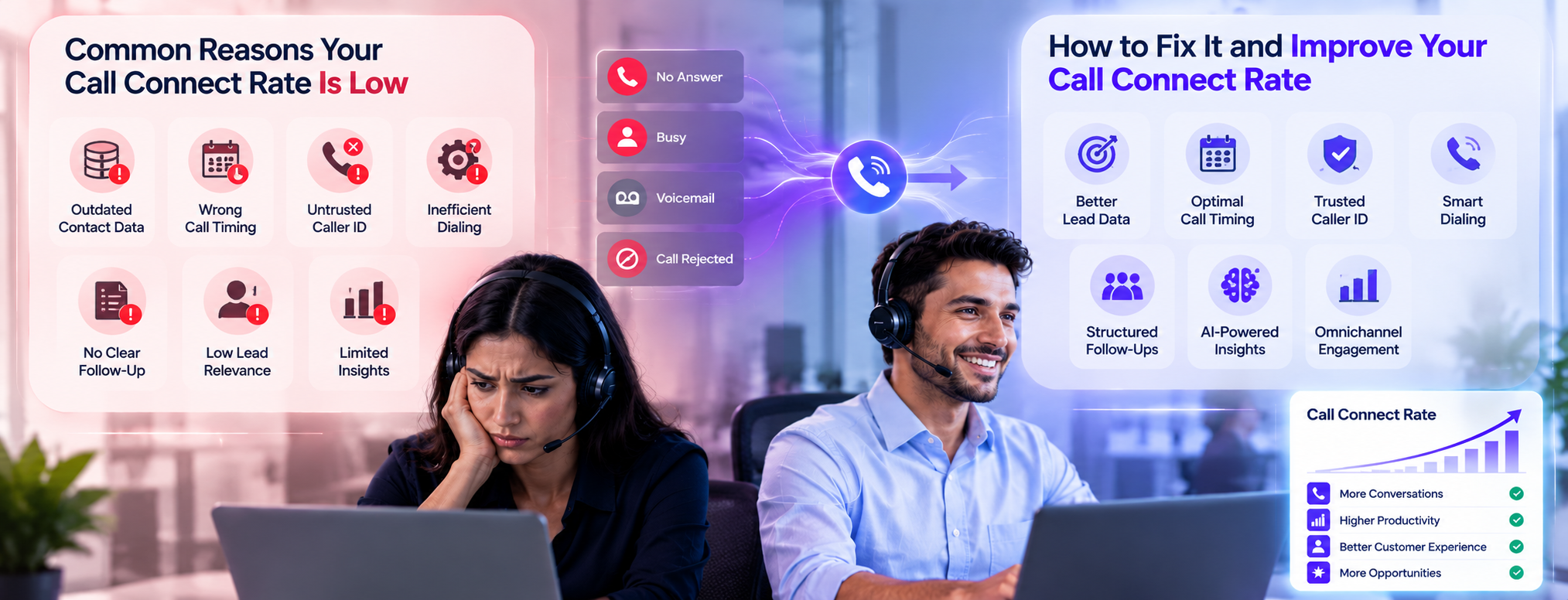
Your sales team is making calls. Your agents are ready. Your campaigns are running. Yet, the conversations that actually matter are not happening.
Customers are not answering. Promising leads remain untouched. Agents spend valuable time waiting, retrying numbers or working through contact lists that deliver little value. Meanwhile, sales targets remain unchanged.
For contact centre leaders, BPOs and sales teams, this is more than a calling problem. It is a problem that affects agent productivity, customer experience, campaign efficiency and revenue opportunities.
A low call connect rate often signals a problem with the way outbound engagement is planned, executed and measured-not simply the number of calls your team makes.
The solution is to understand why customers are not connecting, identify where your outbound process is breaking down, and use better data, smarter dialing, responsible caller ID management and connected customer engagement workflows to improve performance.
This guide explains what causes low call connect rates, how to fix the underlying issues, what to look for in outbound dialer software, and how AI-native contact centre technology can help businesses build a more effective outbound operation.
What Is Call Connect Rate?
Call connect rate is a measure of how successfully an outbound calling campaign reaches its intended audience.
Businesses may define a successful connection differently. Some count any answered call, while others distinguish between an answered call, a live-person conversation and contact with the intended customer.
For meaningful campaign analysis, define the metric clearly and apply that definition consistently.
A high call connect rate can indicate that a campaign is reaching people effectively. However, it does not automatically mean those conversations are relevant, qualified or likely to convert.
For example, a campaign may generate answered calls but struggle to reach the right decision-makers. Another campaign may produce fewer connections but generate more meaningful sales conversations.
The real objective is not simply to connect more calls. It is to create more relevant customer conversations and better business outcomes.
Why Is Your Call Connect Rate Low?
When outbound calling performance declines, the first reaction is often to increase call volume or push agents to make more attempts.
That may increase activity without fixing the underlying problem.
A more effective approach is to examine the entire outbound journey, from contact data and dialing decisions to customer availability, caller identity and follow-up.
Your Contact Database Is Working Against You
Outbound campaigns are only as effective as the contact information behind them.
Incorrect phone numbers, outdated records, duplicate leads and poorly maintained databases cause teams to spend time contacting people they cannot reach or who are no longer relevant to the campaign.
This becomes especially challenging when leads are collected from multiple sources and transferred between marketing automation, CRM and contact centre systems.
How to fix it
Maintain clean contact records, validate phone numbers where possible, remove duplicates and segment leads according to their source, recency, engagement and relevance.
Give priority to people who have recently requested information, scheduled a conversation or shown genuine interest in your offering.
Connect your CRM and dialing workflows wherever possible so agents and campaign managers can work with consistent customer information.
The objective is straightforward: give every calling attempt a better chance of reaching the right person.
Your Team Is Calling at the Wrong Time
A customer can be interested in your product and still be unavailable when your team calls.
Calling patterns that ignore customer preferences, regional time zones, business hours, or previous interactions can reduce the likelihood of a meaningful connection.
The best calling window also varies by audience. A business decision-maker, a retail customer and a patient responding to an appointment reminder may have very different communication preferences.
How to fix it
Analyse campaign outcomes by calling window, lead source and customer segment. Test different permitted contact periods and record requested callbacks accurately.
Use historical interactions to inform future outreach rather than applying the same schedule to every customer.
A smarter calling strategy considers when customers are most likely to engage-not simply when agents are available to dial.
Your Business Number Is Being Ignored
Customers are increasingly cautious about answering unfamiliar calls. If a business number is associated with unwanted calls or appears suspicious, even legitimate outreach can struggle to reach its intended audience.
Caller ID reputation, carrier-level filtering, customer complaints and calling behaviour can all influence whether a call is answered or blocked.
How to fix it
Audit your outbound numbers and investigate unexpected changes in connection performance.
Use legitimate business caller identification and registration mechanisms where available. Maintain a consistent business identity, respect customer preferences and follow applicable telecommunications requirements.
Do not assume every unanswered call is a timing issue. Your business may need to investigate number reputation, call routing or carrier filtering before changing the campaign itself.
A trustworthy calling experience begins before an agent says hello.
Your Dialing System Is Creating Unnecessary Friction
Manual dialing can consume agent time and interrupt the flow of an outbound campaign. Poorly configured automation can create a different problem: calls may be initiated without adequate consideration of agent availability or the ability to handle answered calls.
Both situations can undermine the customer experience and make campaign operations less efficient.
This is where the right outbound dialer software becomes important.
How to fix it
Choose a dialing strategy that matches your campaign and operating model.
Preview dialing allows agents to review customer information before placing a call.
Progressive dialing initiates calls in a controlled workflow as agents become available.
Predictive dialing uses dialing logic to anticipate agent availability and coordinate outbound attempts.
Power dialing, where supported, helps agents move through contact lists with less manual effort.
The appropriate approach depends on campaign complexity, staffing, customer expectations and compliance requirements.
A predictive dialer is not automatically the best choice for every operation. The goal is to find the right balance between efficient outreach, agent readiness and a positive customer experience.
Your Follow-Up Process Has No Clear Strategy
An unanswered call does not necessarily mean a customer is uninterested. The customer may be busy, unavailable or waiting for a more convenient opportunity to speak.
However, repeatedly calling without a clear strategy can create frustration, increase complaints and damage trust.
At the other extreme, abandoning an interested lead after a missed call can result in lost opportunities.
How to fix it
Build a structured follow-up process around customer intent, previous attempts, requested callbacks and campaign objectives.
Record the outcome of each interaction and make the next action clear. Use rule-based retries where appropriate, while respecting contact preferences, consent and opt-outs.
For suitable interactions, coordinate follow-up through channels such as WhatsApp, SMS or email when the customer has the appropriate permissions and the channel is relevant.
A connected follow-up strategy helps businesses remain responsive without making communication feel intrusive.
Your Campaign Reporting Shows Activity, Not Performance
A dashboard filled with call attempts does not tell the full story.
Without visibility into connection outcomes, right-party contacts, qualified conversations and conversions, campaign managers may struggle to understand whether a campaign is reaching the right audience or simply generating more activity.
This can lead to poor decisions, including increasing the budget behind an underperforming campaign or changing agent scripts when the actual issue is poor lead quality.
How to fix it
Measure outbound performance across the entire journey.
Monitor call attempts, answered calls, live-person connections, right-party contacts, qualified conversations, callbacks, conversions and campaign costs.
Segment these results by lead source, campaign, calling window and outbound number where appropriate.
This makes it easier to identify where performance is declining and which changes deserve attention.
The important question is not merely whether your team is making calls. It is whether those calls are creating meaningful opportunities.
How to Improve Call Connect Rate With a Smarter Outbound Strategy
Fixing a low call connect rate requires more than adjusting a dialer setting. It requires a coordinated approach to customer data, campaign execution, agent workflows and performance intelligence.
Prioritise Leads Based on Intent
Not every contact has the same likelihood of engaging with your business.
Someone who has requested a demo or asked for pricing is in a different position from someone who encountered your brand through general awareness content.
Use available CRM information, lead source, recent activity and previous interactions to prioritise outreach.
This allows sales and contact centre teams to focus their efforts on relevant opportunities instead of treating every contact as equally important.
Lead prioritisation should remain transparent and consistent with your data governance and customer communication policies.
Match the Dialing Mode to the Campaign
Different outbound campaigns have different requirements.
Sales prospecting may require agents to review lead information before speaking with a prospect. High-volume, appropriately staffed campaigns may benefit from predictive dialing. Service reminders and callbacks may need a more controlled workflow.
Before choosing outbound dialer software, assess how the system handles dialing modes, agent availability, retry policies, campaign controls and real-time monitoring.
The best solution is not necessarily the one that dials the fastest. It is the one that supports your specific operational goals while protecting the quality of customer interactions.
Make Campaign Management More Intelligent
Campaign performance can change when lead quality, staffing, customer availability or calling conditions change.
A modern outbound operation needs visibility into what is happening and the ability to respond.
Campaign managers should be able to understand which leads are being contacted, how calls are progressing, where connections are being lost and whether the team has the capacity to handle the next interaction.
Real-time monitoring, campaign controls and reliable reporting help teams make informed adjustments rather than relying on guesswork.
Connect Your CRM, Dialer and Customer Engagement Channels
Disconnected systems create unnecessary friction.
When customer details, call outcomes and follow-up activities live in separate systems, agents may lack context and managers may struggle to understand the full customer journey.
Integrating the dialer with CRM and relevant communication workflows helps teams maintain continuity between outreach, conversations and subsequent actions.
Where appropriate, connecting voice with WhatsApp, email, SMS and other supported channels can make follow-up more convenient for customers.
The result is a more coordinated engagement process rather than a collection of isolated communication activities.
Use AI to Understand What Happens During Conversations
Connection is only the beginning of the customer interaction.
Once a call is answered, businesses still need to understand customer intent, identify relevant opportunities, support agents and capture useful information.
AI-powered conversation intelligence can help teams analyse interaction patterns, identify customer intent and sentiment, and surface insights that would otherwise be difficult to extract manually.
AI-assisted agent workflows and automated call summaries can also reduce repetitive work and help maintain better records, depending on the capabilities and configuration of the platform.
These insights can help managers understand whether low campaign performance is caused by reachability, lead relevance, conversation quality or the next step in the sales process.
AI is most useful when it helps teams take better-informed action-not when it simply adds another dashboard.
What Should You Look for in Outbound Dialer Software?
If your existing system cannot provide the visibility, flexibility or workflow control your team needs, it may be time to evaluate a more capable outbound dialer solution.
The right software should fit your operational requirements and connect with the broader customer engagement process.
Flexible Dialing Capabilities
Look for the dialing modes that suit your business, including predictive, progressive and preview dialing where appropriate.
The platform should help you manage campaign rules, agent availability and dialing behaviour without creating unnecessary operational complexity.
Campaign Controls and Real-Time Monitoring
Your team should be able to understand campaign progress, review call outcomes and identify operational issues while campaigns are running.
Useful reporting should make it easier to investigate performance changes and compare relevant campaigns.
CRM Integration and Customer Context
The dialer should work with your existing customer data and support reliable recording of call outcomes and follow-up actions.
Evaluate integration options, data consistency and how easily agents can access relevant information.
Callback and Retry Management
Look for configurable workflows that support requested callbacks and appropriate retry policies.
These features should help teams manage follow-up systematically while respecting customer preferences and applicable calling requirements.
AI and Conversation Intelligence
Consider whether the solution can help your team understand customer intent, support agents during conversations, automate repetitive after-call work and generate useful operational insights.
AI capabilities should have a clear purpose within the workflow rather than being included simply as a product label.
Omnichannel Customer Engagement
Outbound calls are only one part of the customer journey.
If your business engages customers through voice, WhatsApp, email, SMS or chat, consider whether these interactions can be coordinated through a connected platform.
A unified approach can help maintain customer context and make follow-up more consistent.
Compliance, Security and Governance
Evaluate call recording controls, access management, auditability, data handling and the regulatory requirements relevant to your industry and operating regions.
Compliance should be part of the platform evaluation from the beginning, not an afterthought.
Buying recommendation: Choose outbound dialer software based on how well it supports your complete campaign workflow-from prioritising contacts and initiating calls to understanding conversations and managing follow-up.
Why an AI-Native Contact Centre Platform Can Be a Better Fit
For businesses experiencing persistent outbound performance problems, replacing a dialer alone may not address the entire issue.
The dialer can help initiate calls, but campaign results are also influenced by customer context, routing, agent readiness, conversation quality, reporting and follow-up.
This is where an AI-native customer engagement platform becomes relevant.
Aurexion™ is built around a connected approach to contact centre operations, bringing together voice, omnichannel engagement, AI intelligence, workflows, campaign orchestration and agent support.
Instead of treating every stage of customer engagement as a separate activity, Aurexion is designed to connect the processes that help businesses manage interactions more effectively.
Smart Dialing for More Coordinated Outbound Campaigns
Aurexion supports predictive, progressive and preview dialing, along with campaign strategy controls and real-time monitoring.
These capabilities help businesses coordinate outbound calling according to their operational requirements and campaign objectives.
For teams evaluating predictive dialer software or smart dialing solutions, the key consideration is how well dialing fits into the wider contact centre workflow.
Conversation Intelligence That Helps Teams Understand Customers
Aurexion's conversation intelligence capabilities support the analysis of customer intent and sentiment.
This helps businesses look beyond whether a call was answered and develop a clearer understanding of what happens during customer interactions.
When used alongside campaign reporting, these insights can support better decisions about customer engagement and operational improvement.
Agent Assist and Automated Call Summaries
Agents need more than a connected call. They need relevant information, clear next steps and manageable administrative work.
Aurexion's Agent Assist and AI call summary capabilities support agent workflows and help streamline interaction documentation.
By reducing repetitive tasks and improving access to conversation context, these capabilities can help teams focus more effectively on customer interactions.
Connected Voice and Omnichannel Engagement
Customer communication does not always begin and end with a phone call.
Aurexion's omnichannel capabilities bring supported communication channels into a more connected engagement environment, helping businesses coordinate interactions and maintain customer context.
This is particularly relevant for organisations that need to manage outbound campaigns alongside service interactions, callbacks and ongoing customer relationships.
Analytics and Operational Visibility
Effective campaign management depends on understanding what is working and where intervention is needed.
Aurexion's analytics and reporting capabilities support visibility into campaign activity, operational performance and customer interactions.
This helps contact centre leaders move beyond activity-based reporting and make decisions based on a more complete view of their operations.
The Aurexion difference is the connected approach: smart dialing, customer context, conversation intelligence and engagement workflows work together within an AI-native platform rather than being treated as unrelated tools.
Which Businesses Can Benefit From Smarter Outbound Calling?
The value of improving outbound engagement extends across industries, although the priorities vary by use case.
BFSI and financial services: Outbound teams may use structured calling workflows for customer servicing, permitted reminders, relationship management and appropriate follow-up. Governance, customer consent and regulatory requirements remain essential.
BPOs and contact centres: Operations teams need campaign visibility, efficient agent workflows, consistent reporting and the ability to manage different client campaigns.
Retail and e-commerce: Teams may use outbound engagement for service follow-ups, order-related communication and customer relationship management, depending on customer preferences and permissions.
Healthcare: Contact centres may coordinate appointment reminders, service callbacks and patient communication through appropriate channels, with careful attention to privacy and applicable healthcare requirements.
Sales and revenue teams: Businesses can use lead prioritisation, CRM integration and structured dialing workflows to make prospect outreach more organised and measurable.
Across these sectors, the objective remains the same: make every appropriate customer interaction more purposeful, better coordinated and easier to manage.
How to Evaluate Whether Your Outbound Strategy Is Working
Before making major changes to your contact centre technology, establish a clear view of your existing performance.
Start by defining what your organisation considers a successful connection. Separate answered calls from conversations with the intended customer and qualified interactions.
Review performance by campaign, lead source, calling window and outbound number. Investigate whether poor results are associated with contact data, caller ID reputation, customer availability, dialing configuration or follow-up practices.
Next, introduce targeted improvements and assess their impact under comparable conditions.
For example, if you improve lead validation, examine whether the quality of connections improves. If you change your dialing configuration, review agent availability and the handling of answered calls. If you introduce better conversation intelligence, determine whether it helps managers identify issues that were previously difficult to see.
Finally, connect campaign performance to meaningful business outcomes, including qualified conversations, sales opportunities, customer experience and operational efficiency.
The purpose of measurement is not to produce more reports. It is to help your team make better decisions.
Frequently Asked Questions About Call Connect Rate and Outbound Dialer Software
Why is my outbound call connect rate low?
A low outbound call connect rate can result from inaccurate contact data, unsuitable calling times, untrusted caller IDs, inefficient dialing workflows, poor lead relevance or an inconsistent follow-up process. Reviewing campaign outcomes by lead source, calling window and outbound number can help identify the underlying issue.
How can I improve call connect rate without increasing call volume?
Focus on improving contact data, prioritising relevant leads, testing suitable calling windows, managing caller ID reputation and using a structured callback process. Better campaign visibility can also help identify wasted attempts and improve the effectiveness of existing outreach.
What is the best outbound dialer software for a contact centre?
The best outbound dialer software depends on your campaign requirements, agent workflows, integration needs and compliance obligations. Evaluate predictive, progressive and preview dialing, campaign controls, real-time monitoring, CRM integration, callback management and reporting. Consider an integrated customer engagement platform if you also need conversation intelligence and omnichannel workflows.
Can an AI outbound dialer improve call connect rate?
An AI-enabled dialing solution can support campaign coordination, agent availability management and performance analysis. However, actual connection outcomes also depend on contact data, customer preferences, carrier behaviour, caller ID reputation and campaign execution. AI should be evaluated against your operational requirements rather than treated as a guarantee of improved results.
What is the difference between call connect rate and call conversion rate?
Call connect rate measures how successfully outbound attempts reach the audience defined by your reporting rules. Conversion rate measures how often a defined group completes a desired action, such as booking a demo or purchasing a product. A campaign can connect successfully without generating meaningful conversions, so both measures matter.
Is a predictive dialer better than manual dialing?
A predictive dialer can help coordinate high-volume outbound campaigns by initiating calls according to dialing logic and expected agent availability. Manual or preview dialing may be more suitable when each contact requires individual research or preparation. The best approach depends on campaign objectives, staffing, customer expectations and compliance requirements.
How does omnichannel engagement support outbound campaigns?
Omnichannel engagement helps businesses coordinate communication across supported channels such as voice, WhatsApp, email, SMS and chat. When customer preferences and consent are respected, connected workflows can support more consistent follow-up and help maintain context across interactions.
What should I look for when upgrading my contact centre platform?
Assess the complete operating environment, including dialing capabilities, campaign orchestration, CRM integrations, conversation intelligence, agent support, analytics, omnichannel engagement, security and compliance. Prioritise a platform that addresses your actual operational challenges and can support your future requirements.
Final Thoughts: Better Outbound Performance Starts With Better Engagement
When your call connect rate is low, the answer is not always to make more calls.
It may be time to improve contact data, rethink calling schedules, investigate caller ID reputation, refine dialing workflows or understand what happens after a customer answers.
The most effective outbound operations bring these elements together. They connect campaign execution with customer context, agent workflows, conversation intelligence and meaningful performance insights.
That is why choosing the right outbound dialer software should be part of a broader customer engagement strategy.
Aurexion™ brings smart dialing, AI-powered intelligence and connected customer engagement together to help businesses manage conversations more effectively.
If your team is looking to improve outbound campaign management, strengthen agent workflows or modernise its contact centre technology, explore how Aurexion can support your operational goals.
Ready to rethink your outbound calling strategy?
Explore the Aurexion platform or book a demo to discuss your contact centre requirements and see how an AI-native customer engagement approach could fit your business.